East County for self-employed buyers: limits, taxes, older homes
What self-employed buyers priced out of the coast should line up before an East County offer: 2026 loan limits, income proof, county property tax rules and older-home checks.

In this article
Can a self-employed buyer get a home in East County?
- In my files, thin tax returns are where the conversation starts, because some lenders I work with accept business bank statements instead.
- Your loan amount, not the price tag, decides which side of the county's 2026 loan limit you land on.
- According to the San Diego County Assessor/Recorder/County Clerk, buying resets a home's assessment to market value and brings a supplemental bill on top of the regular annual one.
- Under California Department of Real Estate rules, sellers must disclose flood hazard and state fire-risk status, so ask for insurance quotes before you drop contingencies.
- With the California Housing Finance Agency's (CalHFA) Dream For All, the state shares in part of the home's future gain, a real cost later.
Thin returns don't end the conversation in my office. I close bank-statement loans that retail banks turn away. East County trades a longer commute for more house per dollar.
I'm a broker. We shop one file across a network of wholesale lenders instead of living inside one bank's rules. So a no from your bank is one lender's answer. It isn't the market's.
Whether a lender takes statements in place of returns depends on that lender's rules, and only underwriting approves a loan. I lend only in California, through Rate Rebel (NMLS #282828).
Santee, El Cajon and La Mesa: what to check on any home
Santee, El Cajon and La Mesa give you more house per dollar than the coast in exchange for a longer commute. Many homes here are old enough that you should plan the inspection and the insurance before you write an offer.
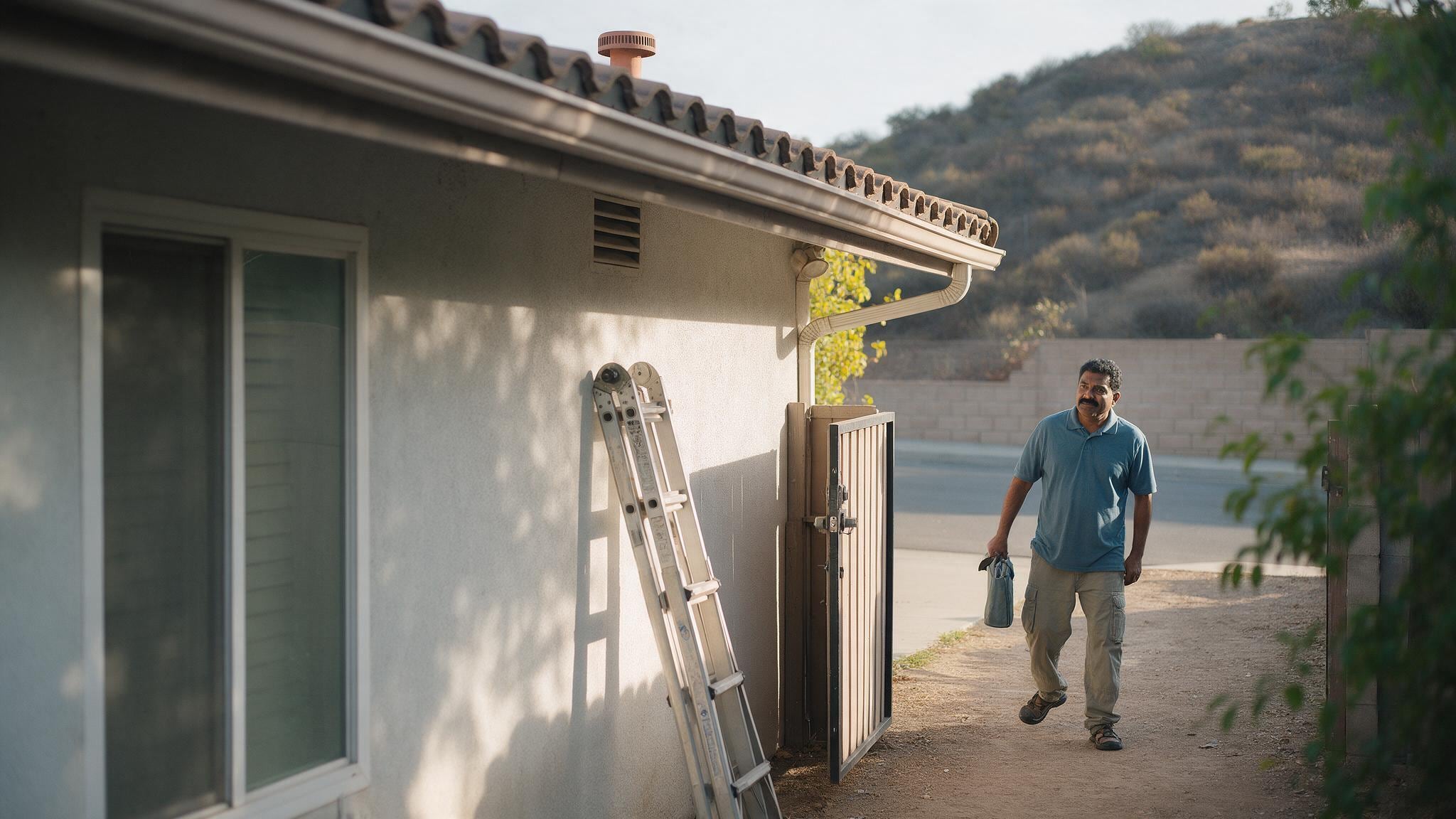
Santee, El Cajon and La Mesa all sell on the same trade: more house for a longer drive. I don't have price or commute figures for each city that I'd stand behind, so I won't guess. Ask your agent for recent sales on the streets you like. The house in front of you decides the work, so run this list on any home you're serious about.
- Test the commute at the hours you'd really drive it before you count the extra space as a win.
- Read the seller's flood and fire disclosures early, since a flood zone brings required flood insurance for most financed homes, and either disclosure can change your insurance quote.
- Ask your inspector to look hard at the roof, plumbing and wiring, because a house built decades ago can hide aging systems.
- Get an insurance quote on the specific address while you can still walk away.
- Look up the parcel's own charges, since bonds and special charges vary by location.
What is the 2026 loan limit in San Diego County?
FHFA's 2026 conforming limit for a one-unit home in San Diego County, California, is $1,104,000. HUD sets the 2026 Federal Housing Administration (FHA) limit for the same home at $1,104,000 too.
| Loan type (2026, one-unit home) | San Diego County limit | Whose figure |
|---|---|---|
| Conforming | $1,104,000 (FHFA) | FHFA, 2026 county loan limit list |
| FHA | $1,104,000 (HUD) | HUD, FHA forward mortgage limits, 2026 |
A conforming loan is one that Fannie Mae and Freddie Mac can buy, and the limit is the largest loan they can buy. For an East County buyer, that means your loan amount, not the price tag, decides which side of the line you're on.
Go over it and you're usually looking at a jumbo loan, meaning a loan bigger than the conforming limit, which carries its own rules. Stay under it and the loan size alone won't push you out of conforming or FHA programs; your file still has to fit their rules.
The limit says nothing about what you personally qualify for. Your income, debts and credit decide that. I walk through sizing the loan first in how to size the loan, not the house.
How do self-employed buyers prove income without full tax returns?
Your tax returns are not the only way to prove what you earn. Bank-statement and asset-based loans are two other routes, and I close both.
If your accountant wrote off everything they legally could, your taxable income drops. That's smart for taxes. It's rough at a bank that reads only the bottom line of a return.
A bank-statement loan usually looks at the deposits hitting your business account instead of the taxable figure. An asset-based loan generally leans on savings and investments you already hold. Each lender sets its own rules for how it counts either one.
Different lenders want different deals. As a broker, I shop your file across wholesale lenders to find one whose rules fit how you earn. The full picture is in how bank-statement loans work, and lenders can look again before you sign, as I cover in whether lenders re-check self-employed income.
When offers come back, compare at least two Loan Estimates line by line. A Loan Estimate is the standard form a lender gives you after you apply, and the lowest rate isn't always the loan that costs you least.
California down payment help for East County buyers
The California Housing Finance Agency's (CalHFA) Dream For All program helped a couple I worked with in Lemon Grove with their down payment. In return, the state shares part of the home's future appreciation when they sell or refinance.
They had steady jobs but not much saved. We sat down with the payoff math before they applied, because that shared appreciation is a real cost later. It isn't free money. They decided stopping rent now beat saving for several more years.
The funds went quickly that round, so I had them get their documents ready early. That's the part I'd copy.
Shared-appreciation help suits a buyer who'd rather own sooner and give up part of the future gain. Keep saving if holding all of that gain matters more than the years of rent. I'm not quoting current program terms here; check CalHFA for the round you'd apply in.
How property taxes work when you buy in San Diego County
According to the San Diego County Assessor/Recorder/County Clerk, a home is reassessed to market value when it changes ownership. After that, under California law, the assessment rises by no more than 2% a year for inflation. So the bill depends on the price paid at the change of ownership. I'd plan around that first bill, since the cap limits how much the assessed value can rise in later years.
The base rate, the Assessor/Recorder/County Clerk says, is 1% plus any bonds, fees or special charges. Those added charges vary by location, so I'd look up the parcel's own list before you offer.
Expect a supplemental bill, too. The Assessor/Recorder/County Clerk must issue it for the gap between the old and new values, prorated by the months left in the fiscal year. The county calls it a supplemental assessment. It comes in addition to the regular annual bill.
| Rule (Assessor/Recorder/County Clerk) | What it says | What it means for you |
|---|---|---|
| Base rate | 1% plus any bonds, fees or special charges | Your total depends on the parcel's added charges |
| Reassessment on sale | Value resets to market when ownership changes, then rises no more than 2% a year | Your bill starts from what you pay |
| Supplemental bill | A prorated bill for the value difference, on top of the regular annual bill | Ask about it before closing so it isn't a surprise |
The county gives no amount or timing for that supplemental bill, so I won't guess one. A tax professional can tell you how property taxes fit your own return.
Older homes: inspections and flood and fire disclosures
In California, a seller must disclose if the home is in a Federal Emergency Management Agency (FEMA) special flood hazard area. Federal law requires flood insurance to finance most structures in that area, according to the California Department of Real Estate.
Fire works much the same way, the Department of Real Estate says. Say the seller knows the home sits in a state responsibility area, or on the state fire map given to the assessor. Then the seller must disclose possible substantial fire risk and the fire-prevention rules on the land.
Neither disclosure tells you which homes are affected or what coverage costs. That's why I'd get insurance quotes before you remove contingencies, while backing out is still possible. An insurance agent is the right person for coverage questions.
Pair those quotes with a full inspection. On an older house, the report is where surprise costs show up, and you want them in hand before the deal is firm.
What the payment actually looks like
The example below uses Freddie Mac's market average rate for April 2, 2026, and your numbers will differ. The annual percentage rate (APR) folds the interest rate and certain loan costs into one yearly figure. That makes it the better number to compare.
| Monthly payment example (as of April 2, 2026) | Amount |
|---|---|
| Home price | $500,000 |
| Down payment | 20% ($100,000) |
| Loan amount | $400,000 |
| Term | 30-year fixed, 360 monthly payments |
| Rate | 6.46% |
| APR | 6.532% |
| Monthly payment (principal and interest) | $2,517.76 |
Example: a $400,000 30-year fixed loan at 6.46% (6.532% APR) with 20% down ($100,000) on a $500,000 home has 360 monthly payments of $2,517.76 in principal and interest. The APR assumes 0.75 discount points ($3,000, the median paid by 2023 home buyers who paid points, according to the CFPB, the Consumer Financial Protection Bureau) and no other lender fees. Taxes and insurance are not included, so the actual payment will be higher. The rate is the market average for April 2, 2026 from Freddie Mac Primary Mortgage Market Survey; yours depends on your credit, loan and property.
Your own payment will look different. The free calculators on our site give an estimate of what you might borrow and the real payment in a few minutes, with no credit pull. For what drives that payment up or down, see what sets your payment.
How I know this
I've done this work for 21 years as a broker, shopping one file across many wholesale lenders, and one self-employed contractor shows why a bank's no doesn't have to be final. His returns showed about half his real earnings after write-offs. We used his business statements, found a lender that liked the deal, and he closed. The tax and limit facts here come from the San Diego County Assessor and FHFA.
Is East County the right move for you?
East County fits a self-employed buyer who can live with a longer commute. You'll also want income you can document, through bank statements or tax returns, and room for the inspection, insurance and a reassessed tax bill. In California, if your loan would top $1,104,000, the county's 2026 limit from the Federal Housing Finance Agency and HUD, or those costs would stretch your payment, rethink the price. Your monthly payment matters more than the price of the house, so run your numbers in the calculator on this page before you tour a single home.
This guide can't tell you a home's flood or fire status, its tax bill or whether you'll be approved. Those come from the seller's disclosures, the county and underwriting.
Thin returns, write-offs and East County: your questions
My tax returns show less than I really make. Can I still buy?
Possibly. Some lenders accept business bank statements in place of returns, and I also close asset-based loans. Whether one fits depends on that lender's rules, and underwriting makes the call.
Do lenders hate self-employed people?
No. A bank can offer only its own rulebook, and some rulebooks are hard on write-offs. As a broker I shop one file across many lenders, and their rules differ.
How many years of returns do I need?
That depends on the lender and the program, and some lenders I work with accept business bank statements in place of returns. I'll tell you what a specific lender wants once I see your file.
My accountant saved me on taxes and now I can't qualify. What now?
Your accountant did their job. The next question is whether a lender will read your deposits instead of your taxable income. I shop your file to look for one whose rules fit how you earn.
Spot something out of date? Tell Sophia.
More like this

Bank-statement loans: how self-employed buyers qualify when their tax returns show less than they make
Your tax returns aren't the only way to prove what you earn. Here's how lenders use your deposits instead, what it costs, and what to do before you look at a house.
Sophia Warner · Sep 26, 2026 · 4 min read
Self-employed jumbo loans in Carlsbad, Encinitas, Del Mar
Where a jumbo loan starts in San Diego County in 2026, why lenders want a stronger file, how bank statements can stand in for thin tax returns, and extra costs.
Sophia Warner · Mar 31, 2026 · 7 min read
Why your lender asks about large deposits
Fannie Mae's 50% large-deposit rule, when a purchase needs a paper trail, what a gift letter must say, and how self-employed buyers can plan ahead.
Sophia Warner · Mar 9, 2026 · 6 min read